


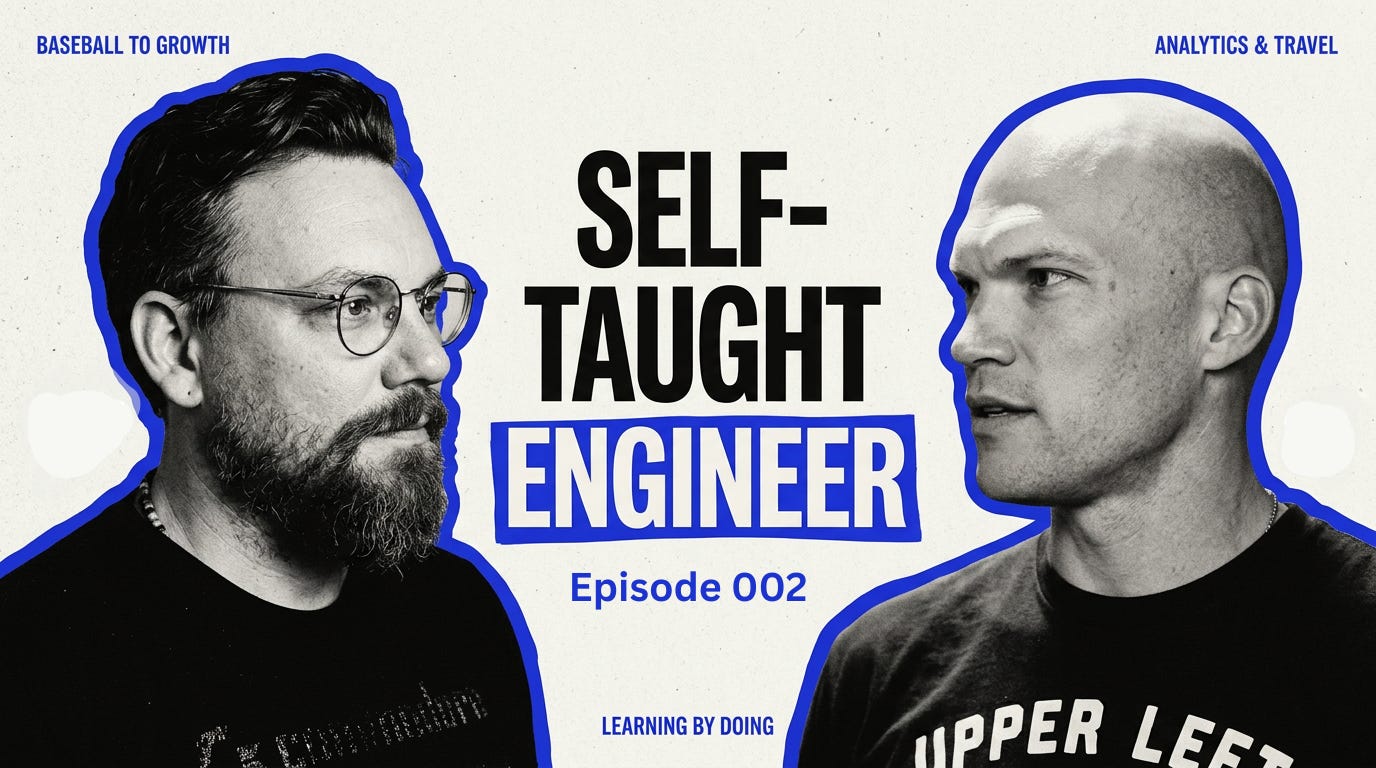
Baseball teaches you something that most careers don’t: the best hitters in the world fail more often than they succeed, and everyone is watching.
Trevor Fox grew up in Aloha, Oregon, where his dad worked at Intel. He started college in landscape architecture, then transferred to UC Davis to pitch Division I baseball. Transfer eligibility rules pushed him into a communications major with a philosophy minor. He read Moneyball while injured. It clicked.
He graduated into the 2008–09 recession. Went undrafted. Played independent ball. Got hit by a car crossing the street, flipped over it, broke his shoulder.
The day after surgery, the Southern Illinois Miners called: they’d acquired him in a trade. He was cut on the last day of spring training, signed and released again, then released after a start in El Paso. He drove to San Diego – “the most depressing time of my life,” in his words. He worked an earthworks crew building reservoirs in Santa Rosa. Then a player-coach spot opened in Holland. He took it. Then Australia, where he drove a forklift between games.
What do you do when the game keeps ending and none of the exits look obvious? Trevor started writing. A Blogspot called “Twenty Six Year Old Boy”, dispatches from Holland, Spain, Prague. That blog got him his first role back in Portland: digital marketing and analytics at a web agency. The hiring manager was a big baseball fan. The blog and the baseball both pulled weight. His clearest advice: do as much in public as you can. Blog, GitHub. It tells people how you think.
From there he moved to a 300-square-foot apartment in Hong Kong, at 6’5”, to consult at Li & Fung. Back in San Francisco, he delivered for Postmates on a bike between jobs, and his tech blog connected him to Optimizely, then to a growth role at Postmates. Zillow had just turned him down for not knowing SQL, so he read Postgres textbooks and learned Redshift on the job. COVID sent him to Census. SVB’s collapse pushed him into fractional work.
Trevor took something less obvious than resilience from the game. A pitcher facing the best hitters in the lineup, runner on second, doesn’t pick one input.
The same instinct shows up in how he learns a business. “You don’t understand a marketplace until you’ve set yourself in the shoes of every part of it,” he told me. Riding for Postmates, he’d get sent to pick up a coffee in North Oakland and carry it up past Berkeley, a 50-minute trip on a bike. Once he was on the growth team, that became a question for SQL: how often are we sending bike couriers on deliveries way outside their range? The question came from the saddle, not the dashboard. He brought the same ground-level approach across his roles.
“Being willing to be uncomfortable is a good character trait,” he said, “because that’s the whole thing about startups. You haven’t proven anything and you have to act like it is proven.”
Bad timing is just timing. What you build inside it is character.
If that resonates, Trevor’s worth following.
Links