


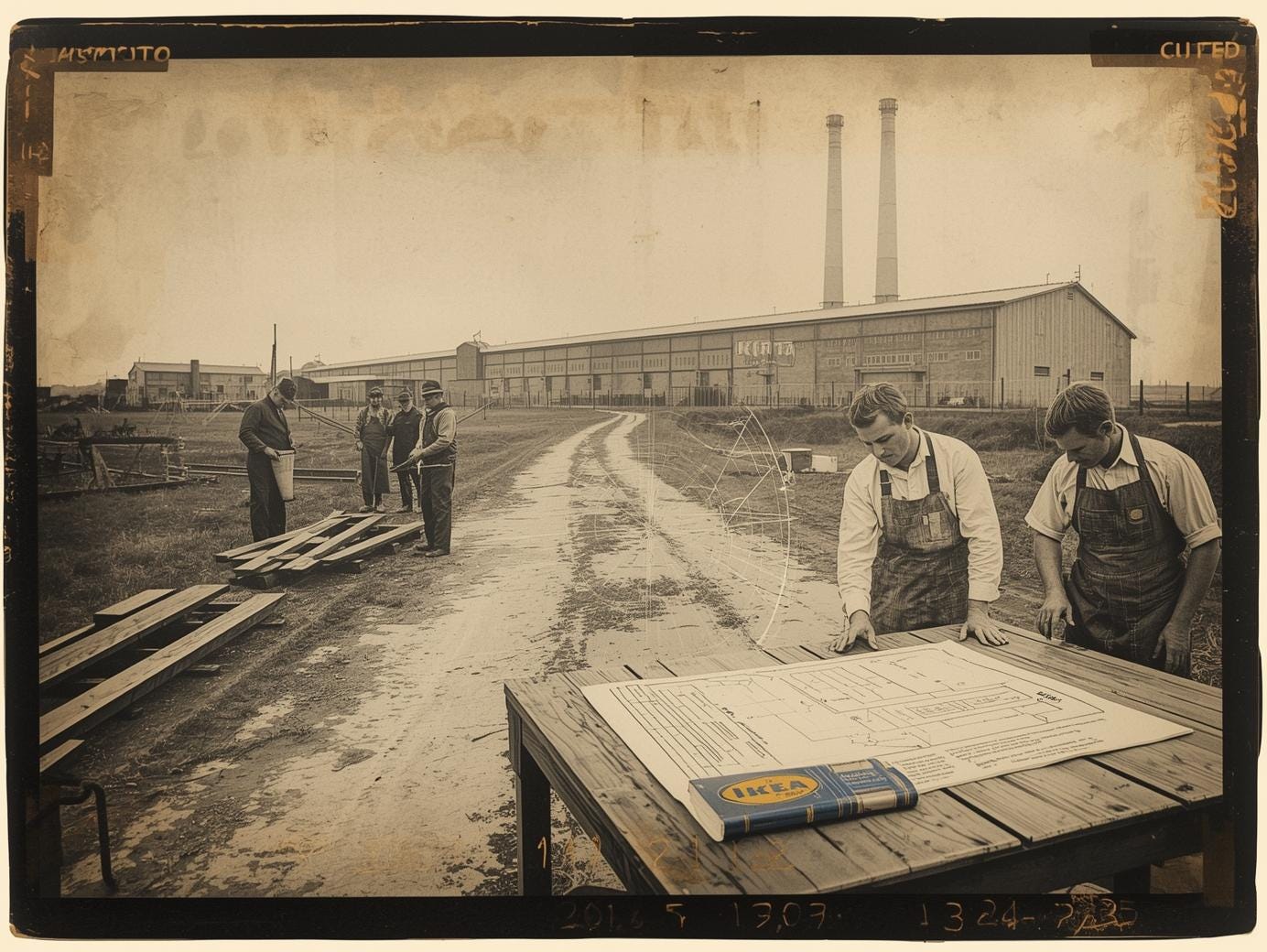
I had an IKEA moment last month.
Not the kind where you stand in aisle 42, wondering why you came for a lamp but left with a kitchen table. Or where you question all your buying choices while pondering the meaning of life.
The kind where you realize the world just changed and you’re not sure if you’re on the right side of it.
I was building a data pipeline; something I’ve done hundreds of times. It used to take me a week of careful architecture, edge case handling, tests, and documentation. The kind of work that, if I’m honest, made me feel like a real engineer. I’d many spent years developing this technical skillset.
Recently I described what I needed to Claude.
One hour later, I finished it, probably because I didn’t have all the answers I needed to complete it in under 15 minutes.
Not a prototype. Not a rough draft. Done and pretty decent. I spent more time writing up the specifics and edge cases than fixing any code.
oh damn….
The Furniture Makers
Before IKEA, furniture was made by craftsmen.
They apprenticed for years. Learned to select wood, join corners, finish surfaces. A master furniture maker spent decades honing their skills.
But, then IKEA came along and said, “What if we just gave people the parts and an Allen wrench?”
The barrier wasn’t skill anymore. It was willingness to follow instructions.
IKEA didn’t kill furniture making. It split the market.
Mass-produced furniture became cheap and accessible. Custom furniture became more valuable. The craftsmen who survived weren’t the ones who could make a basic bookshelf faster. They were the ones who could make something IKEA couldn’t.
We’re Living Through an Industrial Revolution
This isn’t a metaphor anymore. It’s literal.
Chris Loy put it well: for most of its history, software has been closer to craft than manufacture—”costly, slow, and dominated by the need for skills and experience.” AI coding is changing that by making production “cheaper, faster, and increasingly disconnected from the expertise of humans.”
Read that last part again: disconnected from the expertise of humans.
AI handed everyone an Allen wrench for software. The basic stuff the CRUD apps, the data pipelines, the boilerplate code anyone can build it now. You don’t need a CS degree. You don’t need years of practice. You need a clear idea of what you want and the patience to try again. The key is iteration. Many people quit after 2-3 attempts, much like they do when reading an IKEA manual.
If your entire value was “I can write code,” you’re in trouble.
But that was never the whole job.
What has me concerned is that AI coding can be a trap.
It offers shortcuts to incomplete solutions at the expense of the understanding needed for sustainable development. You ship faster. You learn slower. The gap between what you built and what you understand widens with every prompt.
I’ve seeing junior & senior engineers create features in an afternoon. Then, they couldn’t debug them the next morning. The code worked. They had no idea why. When it broke and it always breaks they were stuck.
This is the industrial revolution’s dark side. Mass production disconnects the maker from the craft.
What the Craftsmen Actually Did
The best furniture makers weren’t simply good with their hands; they understood:
What the customer actually needed (not what they asked for).
How the user will use the piece over time
Which corners could be cut and which couldn’t be cut?
When to push back on a bad idea.
How to fix something when it is broken.
The hands-on skill was table stakes. The judgment was the craft.
Same with engineering.
The code was never the hard part. The hard parts are:
Figuring out what to build in the first place.
Knowing when the “simple” solution will become a nightmare at any scale.
Debugging systems that do not have clear error messages.
Communicating technical trade-offs to people who don’t speak your language.
Staying calm when everything is on fire, etc.
AI can write code, but it cannot do the craftsmanship part of it yet.
The Self-Taught Advantage
Here’s where this gets personal.
I don’t have a CS degree. I taught myself everything. I learned Ruby on Rails from YouTube tutorials. I picked up data engineering through late nights and Stack Overflow. Leadership came from making costly mistakes.
For years, I thought this was a disadvantage. I was always catching up to the “real” engineers. The ones who knew the theory. The ones who could whiteboard algorithms without sweating.
But now I’m watching something interesting happen.
The engineers who learned from a curriculum are struggling. They were trained to follow a playbook. When the playbook changes every six months, that training becomes a constraint.
The engineers who taught themselves? They’re thriving.
Because self-taught engineers never had a playbook.
We learned how to learn. We got comfortable not knowing. We built the skill that actually matters now: figuring things out when no one can tell you the answer.
What Kind of Plant Are You?
I read a recent article where a Silicon Valley veteran completely reframed the “AI bubble” question. They argued that we should be thinking of this moment as a wildfire, not a bubble.
This metaphor landed with me.
Wildfires don’t just destroy they’re essential to ecosystem health. They clear the thick underbrush that chokes out new growth. They return nutrients to the soil and create conditions for the next forest generation to thrive.
Some plants are built for fire. Certain pine cones only release their seeds after being scorched. Some species have deep root systems that survive the burn and sprout back stronger.
Other plants just burn.
AI is the wildfire. The question isn’t whether it’s coming; it’s what kind of plant you are.
So what I’m Doing Differently?
I stopped trying to be faster at the things AI can do.
Instead, I’m doubling down on the things it can’t:
1. Judgment calls
AI can generate ten solutions to a problem. It can’t tell you which one will still work in two years. It’s about pattern recognition gained from experience. You learn this by fixing things that broke. I really focus on my systems thinking.
2. Translation
Most business problems aren’t technical problems. They’re communication problems wearing technical clothing. I spend more time now understanding what people actually need than writing code.
3. Leadership under uncertainty
I mentor many individual engineers now. Half of them are scared AI will take their jobs. The other half think AI will solve all their problems. Neither is true. My job is to help them find the middle ground use the tools without losing the understanding.
4. Learning in public
I’ve been coding in BAML (a language for building AI agents) for over a year. Most people haven’t heard of it. By the time it’s mainstream, I’ll have a year of pattern recognition they don’t. I also don’t mind learning the hard stuff—like Rust. I start by manually coding it, then use AI to accelerate my learning.
The New Division
The furniture market didn’t disappear after IKEA. It split:
Mass market: cheap, accessible, good enough
Custom market: expensive, differentiated, irreplaceable
Software engineering is splitting the same way:
Commodity work: AI-generated, cheap, fast, “good enough”
Craft work: human judgment, expensive, slow, essential
The wildfire is clearing the underbrush. The commodity work the basic CRUD apps, the boilerplate, the stuff anyone can prompt into existence that’s burning away. What’s left is the work that requires judgment, context, experience.
The question isn’t whether you can code. It’s whether you can do the things that can’t be automated.
What This Means for You
If you’re a self-taught engineer feeling behind: you’re not.
The skills that made you feel like an imposter like quick learning, problem-solving without help, and adapting to new rules—are the ones that count now.
Engineers with top-notch credentials are discovering what you already know: the playbook won’t help when the game changes.
If you’re early in your career: stop trying to memorize algorithms.
Learn how to learn. Get comfortable with not knowing. Practice explaining technical concepts to non-technical people. Build things that might fail. And when you use AI to ship faster, make sure you understand what you shipped. The shortcut is a trap if you can’t debug what it built.
The best engineers I know aren’t the ones who write the most code. They’re the ones who know when not to write code at all.
The Craftsmen Who Survived
IKEA has been around for over 80 years. Furniture craftsmen still exist.
But they’re not the ones who kept making basic bookshelves. They’re the ones who leaned into what mass production couldn’t replicate: custom work, complex problems, human judgment.
The software engineers who thrive in the AI era will do the same.
Not by competing with AI on speed.
By doing what AI can’t do at all.
The wildfire is coming. Some of us will burn. Some of us will sprout back stronger.
What kind of plant are you?
This is the first in a series about the self-taught advantage in the AI era. If you’re building a career without a traditional CS background, you’re not behind. You might be ahead reach out if you have any questions or want to tell me how wrong I am.
Articles that inspired this post
The rise of industrial software
